In this episode of The Hospital Finance Podcast, Dr. William Padula, Health Economist and Professor at the University of Southern California, and Martin Burns, CEO at Bruin Biometrics discuss the financial burden of pressure injuries. This post summarizes the conversation and we encourage you to listen to the full podcast episode on The Financial Burden of Pressure Injuries here.
Key insights for hospital executives
- Cost follows complexity which makes PI’s a financial problem, as well as a clinical one. Dr. Padula frames HAPIs as one of the most inefficient markets in U.S. healthcare: ~$26–30B/year, >2.5M patients, ~60,000 deaths annually, and more than half of all hospital-acquired-condition spending.
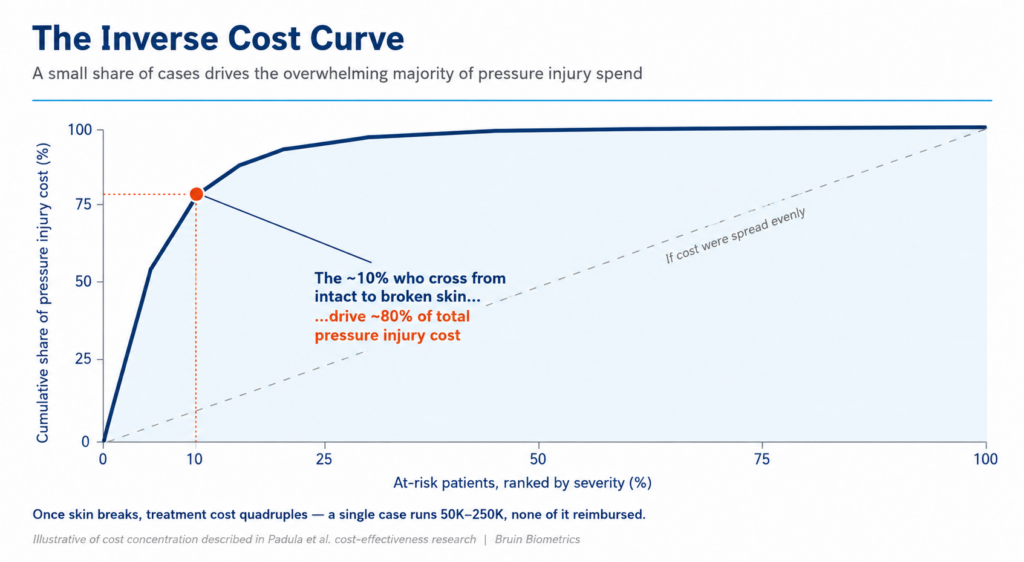
- The inverse cost curve. A small concentration of broken-skin PIs drives disproportionate cost. Once skin breaks, costs quadruple. A single case runs $50K–$250K, none of it reimbursed (CMS non-payment for avoidable HACs), plus penalties and litigation.
- The ROI is in-year and large. Co-authored cost-effectiveness study: ~$4,000 saved per admission, $141 returned per $1 invested, break-even in under a week. Prevention runs ~$100/patient/day vs. a $250K case.
- Targeting, not more effort, is the unlock. ~90% of beds carry no PI risk; ~10% (ICU, surgical, transplant) drive it. Braden scale is subjective and inconsistent. SEM detects sub-epidermal moisture that “precedes and predicts” injury directing scarce nurse time where it matters.
- A real-world scale anchor. One NY IDN (~24 acute facilities): ~9,900 PIs in 2019 = $330M. Most of that variable treatment cost is preventable and bankable the same year.
The Last Harm We Still Manage by Eye
For 60 years, pressure injury prevention has rested on a guess.
The Braden scale scores a patient’s risk. Visual inspection confirms damage that has already happened. Between those two points sits a blind spot — the days when tissue is breaking down beneath intact skin, and a nurse looking right at it sees nothing wrong. By the time the skin shows it, the damage is already days old.
Medicine has closed that exact gap nearly everywhere else. Troponin made a heart attack measurable before it was catastrophic. A1c turned diabetes into a managed number. Lactate gave sepsis an early signal. Pressure injury is one of the last major harms still managed by the naked eye.
That was the throughline of a recent Hospital Finance Podcast conversation between Dr. William Padula, a health economist and professor at USC, and Martin Burns, CEO of Bruin Biometrics. For the C-suite, the reframe matters more than any single statistic: the clinical case for prevention was settled years ago. The operational and financial case — the one that actually moves budgets — starts with seeing the damage earlier.
Why the blind spot persists
It persists because the tools were the best available, and because visual assessment feels objective. A nurse looks, sees nothing, documents accordingly. No one had an affordable, point-of-care biological signal to say otherwise — so the gap became invisible by habit rather than oversight.
That’s the part leadership tends to misdiagnose. Pressure injuries get treated as a vigilance problem — more rounding, more training, more reminders. But you cannot out-effort a blind spot. Asking a nurse to detect damage that isn’t visible yet is asking the impossible, and the best nurse on the floor works with the same naked eye as the newest. Experience narrows the gap; it doesn’t close it. That variability is where prevention quietly fails.
The economics of waiting
The blind spot is expensive in a specific, structural way.
As long as skin stays intact, intervention is comparatively cheap. The moment it breaks, the cost of a case rises sharply, and because CMS classifies these as avoidable hospital-acquired conditions, the hospital absorbs it — largely non-reimbursed, with penalty exposure and litigation risk stacked on top. A patient with an established injury can occupy a bed for weeks, blocking the next reimbursable admission while the wound is treated.
The consequence is a cost curve most finance teams have never seen plotted: a small share of patients — the ones who cross from intact to broken before anyone sees it coming — drives the majority of total pressure injury spend. A CFO sees the damage to margin every month without necessarily seeing the cause.
So the real question isn’t “how do we reduce pressure injuries across the board?” It’s “how do we identify the specific patients about to cross that line, while the damage is still reversible?”
What becomes possible when you can measure it
An objective signal changes the workflow from documentation-and-treatment to genuine prevention. Sub-epidermal moisture, fluid accumulating under skin that still looks healthy — shifts days before anything is visible. Measured at the point of care, it flags at-risk tissue while a clinician’s judgment can still change the outcome, directing scarce attention to the patients who actually need it rather than spreading it evenly across a unit where most carry no real risk.
This is where the financial argument lands. Published cost-effectiveness research on early detection has reported a return of roughly $141 for every dollar invested, with break-even inside the same budget year. The figure strains belief until the logic is clear: early intervention is inexpensive, the avoided outcome is not, and the savings are variable costs you would otherwise have absorbed this year with no reimbursement.
The 2028 forcing function
There is also a clock. Beginning with the CMS electronic clinical quality measure (eCQM) Hospital Harm – Pressure Injuries requirements taking effect in 2028, pressure injury performance becomes a reported, scored, publicly visible number rather than an optional quality metric.
Subjective assessment makes that number noisy and hard to defend in front of auditors and the board. An objective, consistent measurement standard does the opposite: it creates the documentation trail the mandate will require and gives quality improvement a real leading indicator. The hospitals getting ahead of it are building that infrastructure now, while it’s a choice rather than a scramble.
The bottom line for the C-suite
Preventing pressure injuries isn’t primarily a cost to manage. It’s financial and operational bandwidth to recover, and capital and capacity currently lost to damage discovered too late.
The deeper shift is quieter. Once the biology can be measured, “wait and see” stops being standard of care and becomes a decision, one most hospitals have never consciously made. The teams getting to zero aren’t trying harder. They’re finally able to see what they were always being asked to catch.