Background
$1.57M in Annual Treatment Costs from Sacrum & Heel HAPIs — 70% Outside the ICU
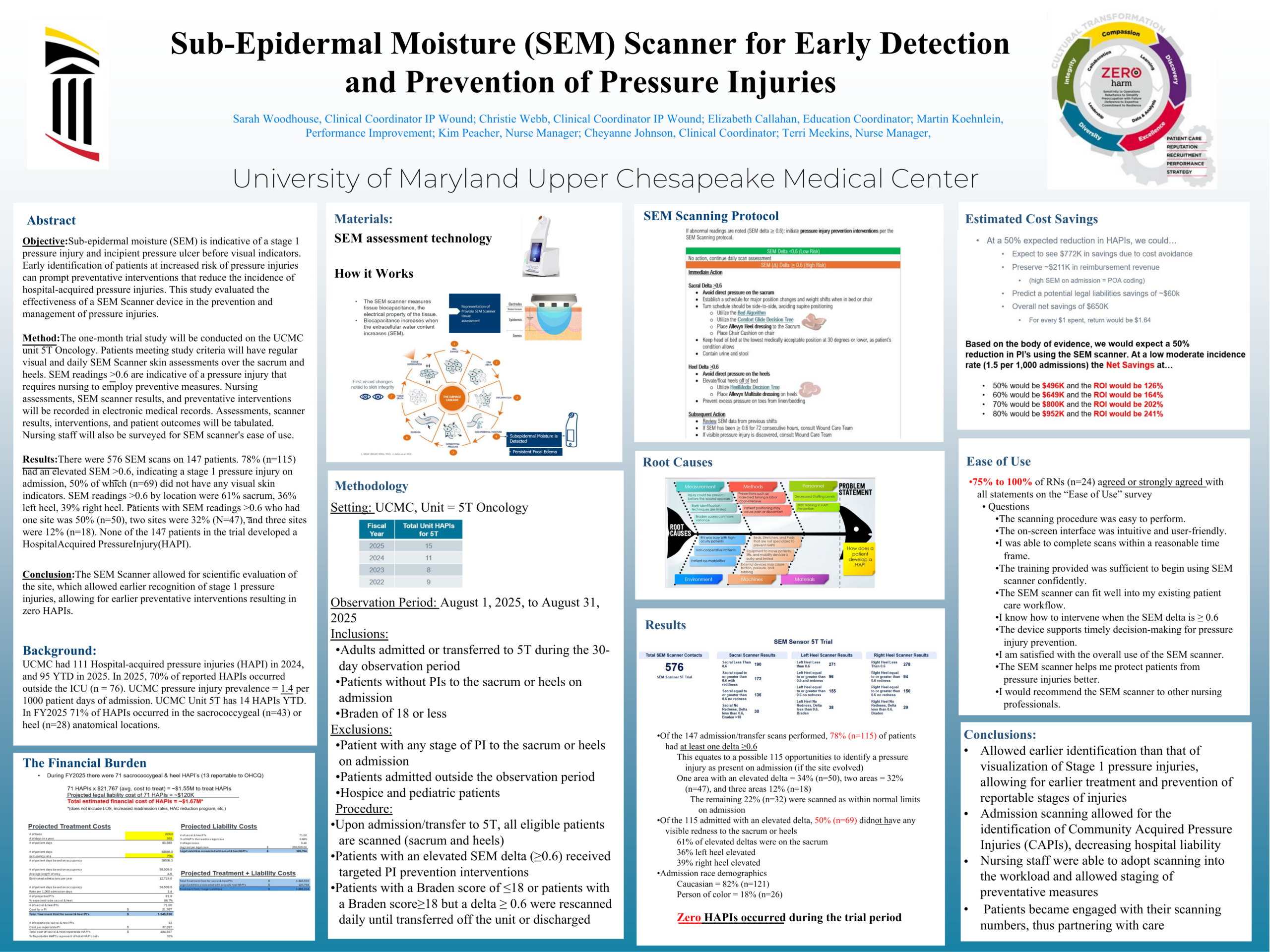
The medical center recorded 111 hospital-acquired pressure injuries in 2024 and 95 year-to-date in 2025. In 2025, 70% of reported HAPIs (n=76) occurred outside the ICU. Hospital-wide pressure injury prevalence was 1.4 per 1,000 patient days.
In FY2025, 71% of HAPIs (n=71) developed on the sacrum or heels — generating an estimated $1.57M in annual treatment costs, before reimbursement penalties and litigation exposure. The medical center’s inpatient oncology unit had accumulated 14 HAPIs year-to-date. Oncology patients face elevated PI risk from immunosuppression, nutritional deficits, and prolonged immobility, and the hospital sought an objective, evidence-based detection tool to close the gap between admission and clinical escalation.
These results were presented at the 2026 Mid-Atlantic Patient Safety Conference. You can see the poster here and find more detail below:
Methodology
Prevention Requires Early Detection. Early Detection Requires SEM Scanning.
Between August 1 and August 31, 2025, a one-month trial study was conducted on the oncology unit. Eligible adult patients (admitted or transferred to the unit without sacral or heel PIs, Braden score ≤18) received Provizio SEM Scanner assessments of the sacrum and heels. Elevated SEM deltas (≥0.6) triggered targeted prevention interventions per the SEM scanning protocol.
Phase 1: Admission Screening
- All eligible patients scanned on admission/transfer to the unit
- Elevated SEM delta (≥0.6) triggered targeted PI prevention interventions
- Interventions and SEM readings documented in EPIC EHR
Phase 2: Daily Surveillance
- Daily rescans for Braden ≤18 or any patient with an elevated delta
- Continued until discharge or transfer off unit
- Staff surveyed on workflow fit and ease of use
Results Achieved
30 Days
Zero HAPIs
Across 147 patients and 576 scans during the trial
30 Days
57 Invisible Stage 1 PIs Caught
50% of flagged patients had no visible redness to sacrum or heels
30 Days
115 Early Interventions Triggered
78% of patients had an elevated SEM delta ≥0.6 on admission
Annualized
$496,000 Net Savings
Modeled at a conservative 50% HAPI reduction scenario
Annualized Impact*
126% ROI
Scales to 241% ROI under 80% reduction scenario
Annualized
$2.26 Return per $1 Spent
At 50% reduction; scales to $3.41 at 80% reduction
Annualized figures reflect the source trial study’s modeled scenarios at a conservative low-moderate HAPI incidence assumption (1.5 per 1,000 admissions): $496K net savings / 126% ROI at 50% reduction; scaling to $952K / 241% ROI at 80% reduction. Modeled estimates — subject to clinical and finance review.
Conclusion
Zero HAPIs Across 147 High-Risk Oncology Patients in a Single Month
Objective SEM assessment identified stage 1 pressure injuries earlier than visual skin assessment often before any visible indicators, enabling earlier preventive intervention, distinguishing community-acquired from hospital-acquired injuries at admission, and keeping existing nursing workflow intact.
Why These Outcomes Matter
Zero HAPIs in one month with half of stage 1 injuries invisible to the naked eye.
- Protects oncology patients with compromised skin integrity from progression to reportable stage 3 and 4 injuries.
- Separates community-acquired pressure injuries from HAPIs at admission, reducing false-attribution liability.
- 75–100% of RNs agreed the SEM Scanner fits existing workflow, supports decision-making, and is easy to use.
Modeled $496K–$952K in annualized savings; 126%–241% ROI on a single unit.
- Every $1 invested returns $2.26–$3.41 in avoided treatment costs and reimbursement recapture.
- Reduces CMS nonpayment exposure from preventable stage 3–4 HAPIs on the sacrum and heels.
- Proves scalability to non-ICU settings where 70% of the hospital’s HAPIs actually occur.